
Second phase of mural ‘Tula den kada un di nos’ highlights 13 local heroes
December 22nd, 2025
Second phase of mural ‘Tula den kada un di nos’ highlights 13 local heroes
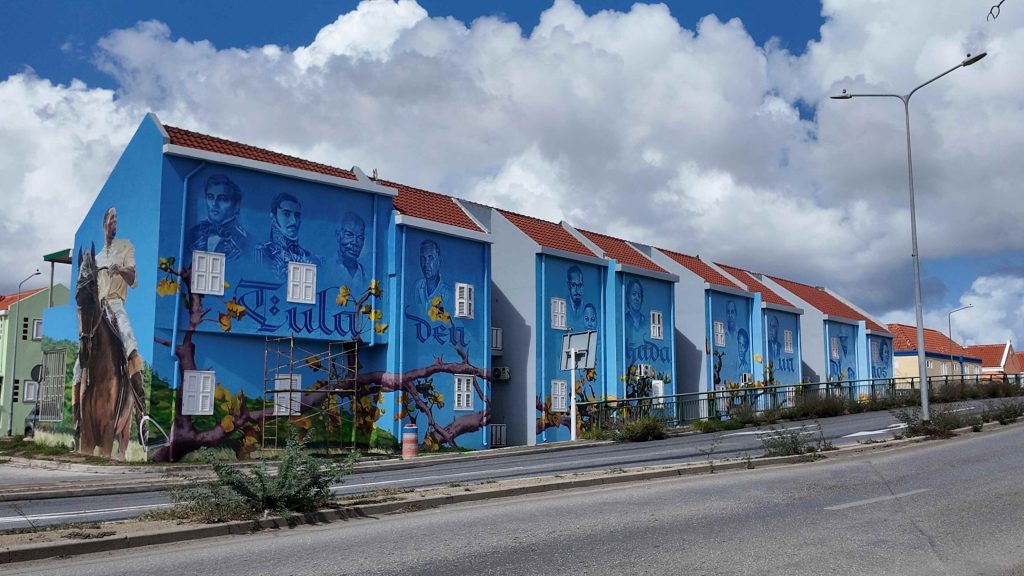
WILLEMSTAD – On Sunday, 21st of December, the Slavery Memorial Committee unveiled the second phase of the mural Tula den kada un di nos (Tula in all of us), a powerful and layered artwork by Curaçaoan artist Garrick Marchena. While the first phase depicted Tula prominently in white — mounted on a horse as a symbol of resistance, dignity and unbreakable strength — this second phase focuses on thirteen other Curaçaoan heroes, each of whom made a lasting contribution to the development and emancipation of the Curaçaoan community.
These men and women are not presented as isolated figures from the past, but as carriers of the same spirit embodied by Tula. Each of them carried Tula within them: in word and deed, in culture and leadership, in struggle and in care. Tula den kada un di nos thus does not mark an endpoint, but an invitation — to remember Tula not only as history, but to recognize him within ourselves and one another.
The thirteen Curaçaoan heroes honored in this second phase are:
- Manuel Carlos Piar – military leader and freedom fighter;
- Philippus (Pedro) Ludovicus (Louis) Brion – naval hero and strategist of the regional independence movement;
- Felix Chacutu – resistance figure and advocate for Afro-Curaçaoan rights;
- Medardo de Marchena – radical thinker and activist who challenged colonial power structures;
- Dr. Moises Frumencio da Costa Gomez – statesman and architect of political emancipation;
- Angela Altagracia (Tata) de Lannoy-Willems – community pillar and role model in care and upbringing;
- Carmen Cecilia Nieuw-Zielinski – socially engaged woman and cultural bearer;
- Pedro Tirso Maria Sprockel – champion of Papiamentu in education and dedicated himself wholeheartedly to youth care. Among other things, he helped establish the Federation of Antillean Youth Care in 1953;
- Pierre Lauffer – poet who elevated Papiamentu as a language of pride;
- Elis Juliana – writer and folklorist who preserved Afro-Curaçaoan culture;
- Amador Nita – advocate for social justice;
- Wilson (Papa) Godett – trade union leader and symbol of collective resistance;
- Adele Rigaud – educator and pioneer of educational emancipation.
“These thirteen heroes helped shape Curaçao. In their thinking, their struggle, their care and their creativity lies the foundation of who we are today as a community. By making them visible alongside Tula, we acknowledge that emancipation was not a single moment, but a process — carried by many, across generations. This is a tribute, but also an invitation: to keep their courage alive in the way we live together today,” said Lucia Beck, Director for the Caribbean part of the Kingdom at the Slavery Memorial Committee.
With this second phase, Tula den kada un di nos affirms itself as a living monument — visible in public space, felt in conversation and continuing to resonate across generations.
The unveiling was part of the Kurashi Year End Celebration, the year-end gathering of the Slavery Memorial Committee and their broader #Kurashi #Courage movement. The mural was one of three stops along a Kurashi Walking Tour through Otrobanda, where art, history, oral tradition and music came together in the public space.
Another stop was the birthplace of Nilda Pinto, a distinguished Curaçaoan educator and community figure who shaped generations of children and was deeply committed to knowledge transfer and cultural awareness. At this location, a performer brought Nilda Pinto to life and shared a Kompa Nanzi (Anansi) story, highlighting the importance of oral tradition and folk storytelling.
The third stop took place at the mural of Kemuël Sandries beneath the viaduct, where attention was given to the origins and meaning of Tambú as a form of resistance, expression and collective healing. A dancer explained the story of Tambú and brought it to life through movement, accompanied by a group of musicians playing traditional tambú and other authentic instruments, including the kachu and the chapi.
Following the walking tour, the public gathered at the Riffort for a traditional, open year-end celebration accessible to all of Curaçao. Live performances of aguinaldo, gaita and tambú music marked a communal closing of the year — rooted in tradition, sustained by community and oriented toward the future.
About the Slavery Memorial Committee
The Slavery Memorial Committee was officially founded on January 6, 2025, and is active throughout the Kingdom of the Netherlands. The committee has offices in the Netherlands, on Curaçao (Otrobanda), and on St. Eustatius (Oranjestad). From these locations, it works to promote remembrance, awareness, and recognition of the history of slavery and its lasting impact on the present.
Note to editors: For more information, please contact Communications Advisor Kim Sambo at +5999 5237860 or kim.sambo@hc-slv.org.